How to keep Speed Reading Resolutions
Have you made any new year’s resolutions? Why not make Learning to Speed Read one of them? According to a 2016 study, of the 41% of Americans who make New Year’s resolutions, by the end of the year only 9% feel they are successful in keeping them. There are similar statistics for other countries.
Resolutions are fragile. If you set a big goal without flexibility and a plan of the steps needed to reach it, you are likely to fail. You don’t have to wait till January 1st to commit to a Speed Reading programme. Any start date will work.
The key to improving anything (and specifically reading) is to develop a new habit of sustained action. I suggest you read for 10 minutes five days a week. No matter how busy you are it should be possible to find 10 minutes and if you miss a day or two you have the weekend to catch up.
Management consultant and educator, Peter Drucker is often quoted as saying that “you can't manage what you can't measure.” For each practise reading count the number of words you read in 10 minutes to determine your speed in Words Per Minute. This is easy with a digital document as any word processor will give you a word count. If it is a printed book you can estimate the number of words by multiplying the average number of words per line by the number of lines read. Record your progress.
Wise Songs
Reading should be a pleasurable experience. Read material you enjoy and develop a love of books and literature. The Beatles sang:
“There's nothing you can know that isn't known
Nothing you can see that isn't shown
There's nowhere you can be that isn't where you're meant to be
It's easy
All you need is love”
Former Beatles guitarist, George Harrison sang of a slightly different message in 1987 in “got my mind set on you” (actually a cover of a 1962 song written by Rudy Clark and sung by James Ray):
“But it's gonna take money
A whole lotta spending money…
It's gonna take time
A whole lot of precious time
It's gonna take patience and time, mmm
To do it, to do it, to do it, to do it, to do it
To do it right”
[By the way if you haven’t seen it I recommend you Google the second video music video for the song. It features Harrison playing a guitar while seated in a country house study. As the song progresses, furniture and objects begin to sing or dance along with the song like a comedic haunted house movie. It was nominated for three MTV Video Music Awards.]
Learning to speed read is easy. It takes love, time and money, though not as much as you may think. Invest in a book or a course training in the techniques then practise little and often as I have already mentioned.

Kaizen
Kaizen is a Japanese business philosophy meaning "continuous improvement." It involves tiny incremental steps to improve performance or efficiency where employees at all levels of a company work together.
Tony Buzan talks about a similar principle he calls the ‘plus one rule’:
“Whenever you are consciously attempting to read faster, aim to read at least one work per minute faster than your previous highest speed. In this way you will not put unnecessary stress on yourself, and you will often find you have increased by ten or more words per minute, thus comfortably beating your goal, which leads to increasing confidence and faster and more efficient reading.”
While this strategy is all well and good. I would edit it a little. Increasing by a fixed amount, of say one word per minute, leads to what is called an ‘arithmetic progression’. If you want to increase your speed by a thousand words you, in principle, need to do 1000 trials. I’m inherently lazy if I can get better results by working smarter then that’s the way for me.
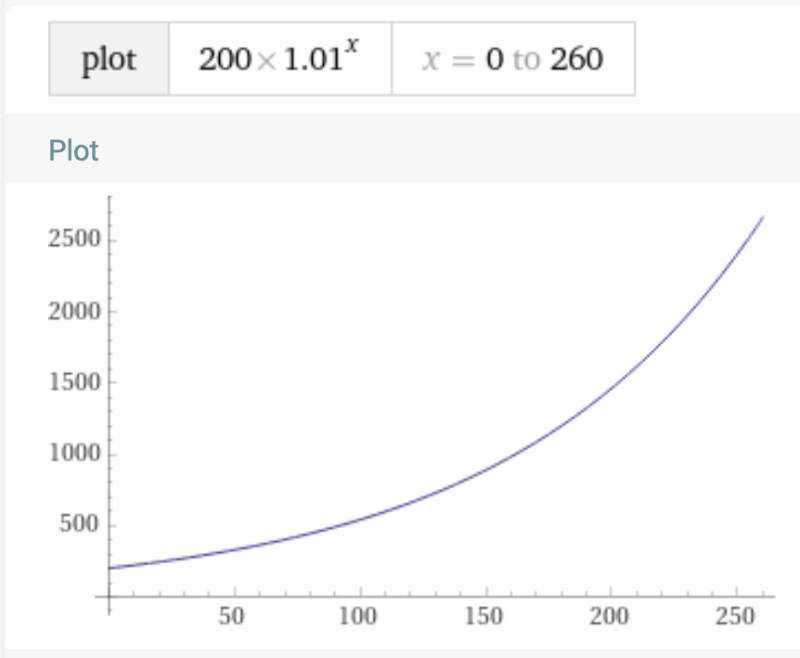
Instead of a fixed number of words, aim to increase your speed by 1% (whilst maintaining comprehension) with each reading. This subtle change creates what’s called a ‘geometric progression’. Instead of adding we are multiplying each time. It is a cumulative effect. A little computer simulation shows this quantitatively. Take 1% increments starting with a low average speed of 200 words per minute over a year (52 weeks x 5 days a week = 260 steps).
10 let x = 200
20 for y = 1 to 260
30 let x=x*1.01
40 next y
50 print int(x)
You get a final figure of 2,658 words per minute. This is worthy of entering the World Speed Reading Championships and is certainly achievable.
Another way of expressing this is the following formula. Don’t worry about the maths too much.

The final speed is the initial speed times the common ratio of increase to the power of the number of trials. We can show this graphically:
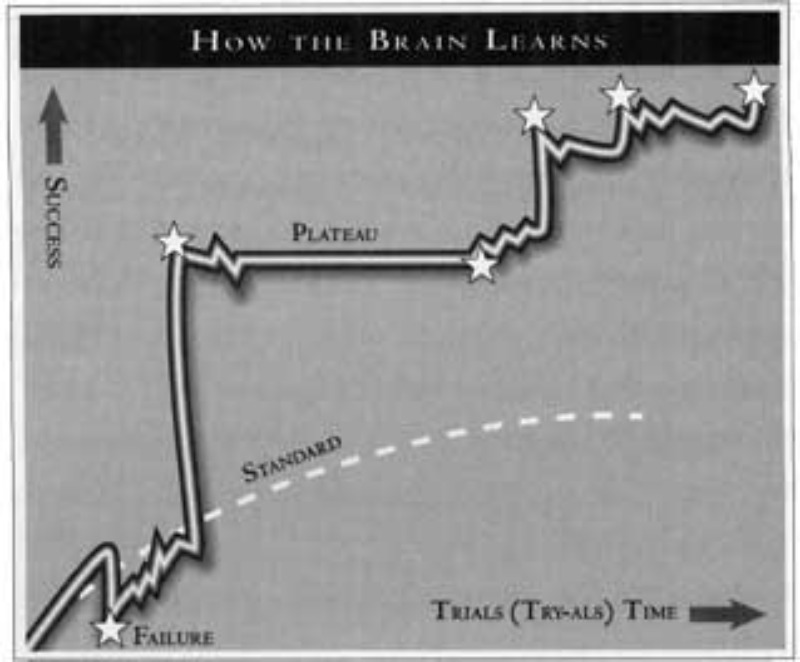
In reality the learning curve doesn’t follow a smooth progression like this. There will be big successes, major failures and plateaus but these cancel each other out so an average 1% increase per reading is definitely realistic.
A typical novel is around 60,000 words so at this final speed you can read it in just over 22 minutes if you so choose.
Why Read Fast?
American President Harry S. Truman said, “Not All Readers Are Leaders, But All Leaders Are Readers”. Top business people often quote President Truman's philosophy as one of their keys to success. Billionaire investor, Warren Buffett has a reputation for being a prodigious reader. He can spend as much as six hours per day reading books and newspapers. Buffett believes it's important to spend time exercising your mind through daily reading and thinking in order to make informed decisions.
We don’t generally have the luxury or spending all day reading but reading faster and often is the next best thing. A good resolution for anyone!